
Awesome-Real2Sim

A research map of nearly 300 papers

  • Sorted by what each paper deliversEach paper has exactly one place.
  • Tagged with how it is builtFrom optimization to language-model agents.
  • A roadmapKey methods and benchmarks on one route, month by month.
  • Open to contributionsAdd a paper with one entry or one issue.
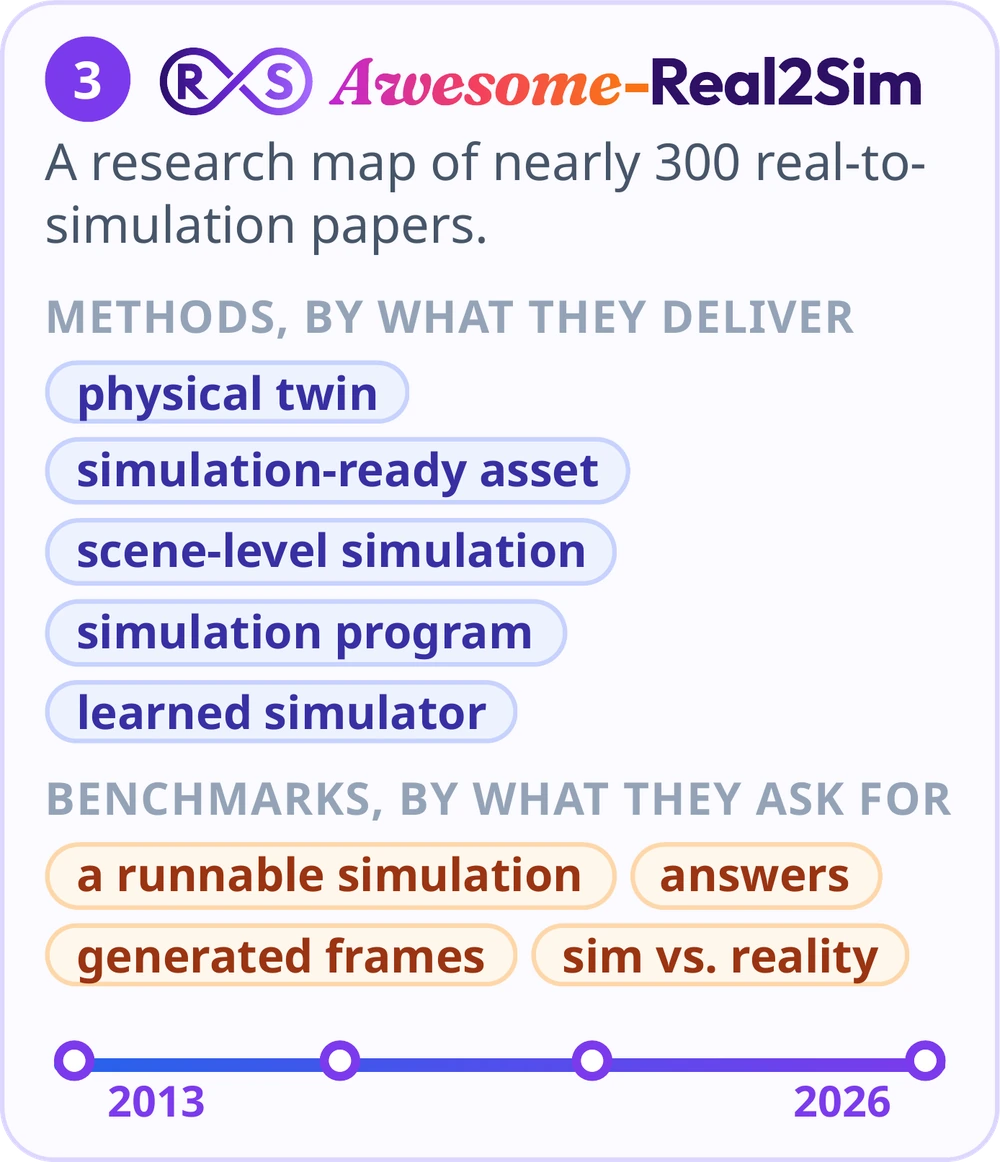
Awesome-Real2Sim at a glance, from Figure 1 of the Real2SimLab paper: a research map of nearly 300 real-to-simulation papers; methods by what they deliver (physical twin, simulation-ready asset, scene-level simulation, simulation program, learned simulator); benchmarks by what they ask for (a runnable simulation, answers, generated frames, sim vs. reality); and a timeline from 2013 to 2026.
  • ⋆Equal contribution
  • †Co-project leaders
  • ✉Corresponding author
  • 1State Key Laboratory of General AI, School of Intelligence Science and Technology, Peking University
  • 2Ngoro Robotics
  • 3School of Physics, Peking University
  • 4The University of Hong Kong

A map of a scattered field

Real-to-simulation papers come from vision, graphics and robotics, and they deliver very different things: physical twins, simulation-ready assets, whole scenes, programs and learned simulators. Awesome-Real2Sim puts their methods, benchmarks, datasets and surveys on one map.

Overview of Awesome-Real2Sim. Left, methods in six categories by what they deliver: physical twins with identified or assigned parameters, sim-ready assets, scene twins, simulation programs and learned simulators. Right, benchmarks in four categories by what is handed in (a runnable simulation, prediction and reasoning, generated video, sim-real agreement), datasets and surveys. In the middle, the list itself: methods, benchmarks, datasets, surveys and the map.

Scroll sideways to see the whole figure.
Methods by what they deliver (left); benchmarks, datasets and surveys (right).
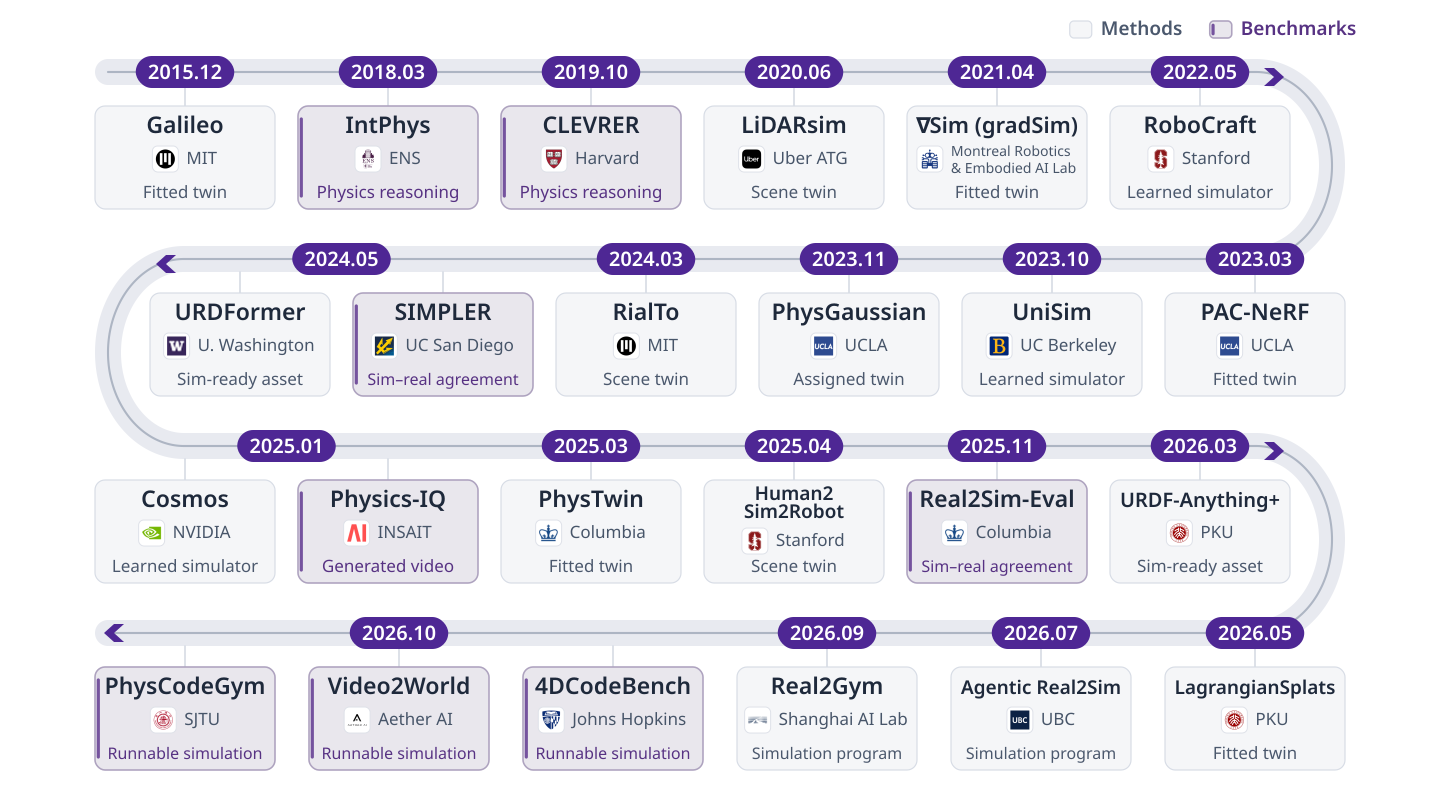
Roadmap of real-to-simulation, a route that winds through four rows of key works, each dated by month: Galileo, IntPhys, CLEVRER, LiDARsim, gradSim and RoboCraft; PAC-NeRF, UniSim, PhysGaussian, RialTo, SIMPLER and URDFormer; Cosmos, Physics-IQ, PhysTwin, Human2Sim2Robot, Real2Sim-Eval and URDF-Anything+; LagrangianSplats, Agentic Real2Sim, Real2Gym, 4DCodeBench, Video2World and PhysCodeGym. Benchmarks have a violet edge.

Scroll sideways to see the whole roadmap.

Key works, dated by the month of their first arXiv version (Galileo: its conference). Benchmarks have a violet edge.

Sorted by what each paper delivers

Methods are sorted by what they deliver, benchmarks by what the system under test must hand in.

Taxonomy. Six questions asked in order send a method to its category: adjacent directions, learned simulator, simulation program, scene twin, sim-ready asset, physical twin with identified parameters, or physical twin with assigned parameters. Below, benchmarks are sorted by what the system under test hands in: a runnable simulation, prediction and reasoning, generated video, or sim-real agreement; data without an evaluation protocol is a dataset.

Scroll sideways to see the whole figure.

A few questions, asked in order, give each paper its category.

Contribute

Missing a paper? Add one entry or open an issue: see CONTRIBUTING.

BibTeX

If you use either project, please cite our paper:

@article{real2simlab2026,
  title   = {Real2SimLab: A Unified Platform for Real-to-Simulation Transfer},
  author  = {Zhang, Yongchang and Huang, Jie and Ni, Yunhe and Zhou, Ningyu and Zhao, Guangyu and Liu, Ruixun and Huang, Rui and Wu, Yidi and Zhang, TianZe and Jiang, Zixiang and Li, Xiang and Shen, Kevin and Zhong, Yiwu},
  journal = {arXiv preprint arXiv:2611.34849},
  year    = {2026}
}